Boston, MA Neighborhood Guide: Walkable Urban Living for Young Professionals
Explore Boston’s high-energy urban vibe: Walk Score 82.8, Transit Score 72.4, MBTA access, Seaport nightlife, condos, and brownstones.
Written ByMargie Gundersheim
PublishedJuly 24, 2026
UpdatedAugust 4, 2026
We're the Gundersheim Group Real Estate team, award-winning Realtors serving Newton, MA and Greater Boston. We guide buyers and sellers from first search to closing. Serving Newton, Brookline, Wellesley, Needham, Natick, Westwood, Medfield, Dedham, Boston, Wayland, Belmont, Lexington and Watertown, MA.
Boston, MA
Region
# Boston, MA Neighborhood Guide: Urban Living for Young Professionals
Boston isn't a city you ease into—it's one you plug into. If you're building a career in finance, tech, biotech, healthcare, or education, this is a place where your apartment, your gym, your favorite coffee spot, and your office can all sit within a fifteen-minute walk of each other. This guide breaks down the vibe, the housing stock, the social hubs, and the commute, so you can figure out exactly where you fit.
What Is the Vibe Like in Boston, MA for Young Professionals?
Boston delivers a high-energy, walkable, historic-meets-modern atmosphere where you can live car-free and still have world-class dining, nightlife, and green space at your doorstep. It's dense, fast-moving, and layered—cobblestone streets on one block, glass towers on the next.
What sets Boston apart for young professionals is how compact the energy is. You're never far from a rooftop bar, a waterfront run, or a late-night bite. When I walk clients through neighborhoods, the thing that clicks for most people is realizing they can genuinely ditch the car. Grabbing a morning coffee at Gracenote Coffee in the Leather District before hopping on the T is a completely ordinary Tuesday here.
The mobility scores back up what you feel on the ground:
Boston Urban Mobility Scores
Boston scores strongly for car-light living, with a high Walk Score and solid transit access—key lifestyle factors for young professionals prioritizing dense, urban convenience.
Boston scores strongly for car-light living, with a high Walk Score and solid transit access—key lifestyle factors for young professionals prioritizing dense, urban convenience.
With a Walk Score of 82.8 and a Transit Score of 72.4, Boston lands firmly in "very walkable" territory—exactly the profile that draws the car-light, socially active crowd. Compared to the quieter western suburbs like Newton or Wellesley, where our team spends a lot of time, Boston trades yards and driveways for immediacy. Everything is closer, louder, and more spontaneous.
A few highlights of the day-to-day:
•A near-24/7 metropolitan feel, especially in the core neighborhoods and along the waterfront.
•A seamless blend of old and new, with Freedom Trail history threading past modern high-rises.
•A thriving social scene built around craft breweries, rooftop patios, and a dense restaurant culture.
What Are Condos and Townhomes Like in Boston, MA?
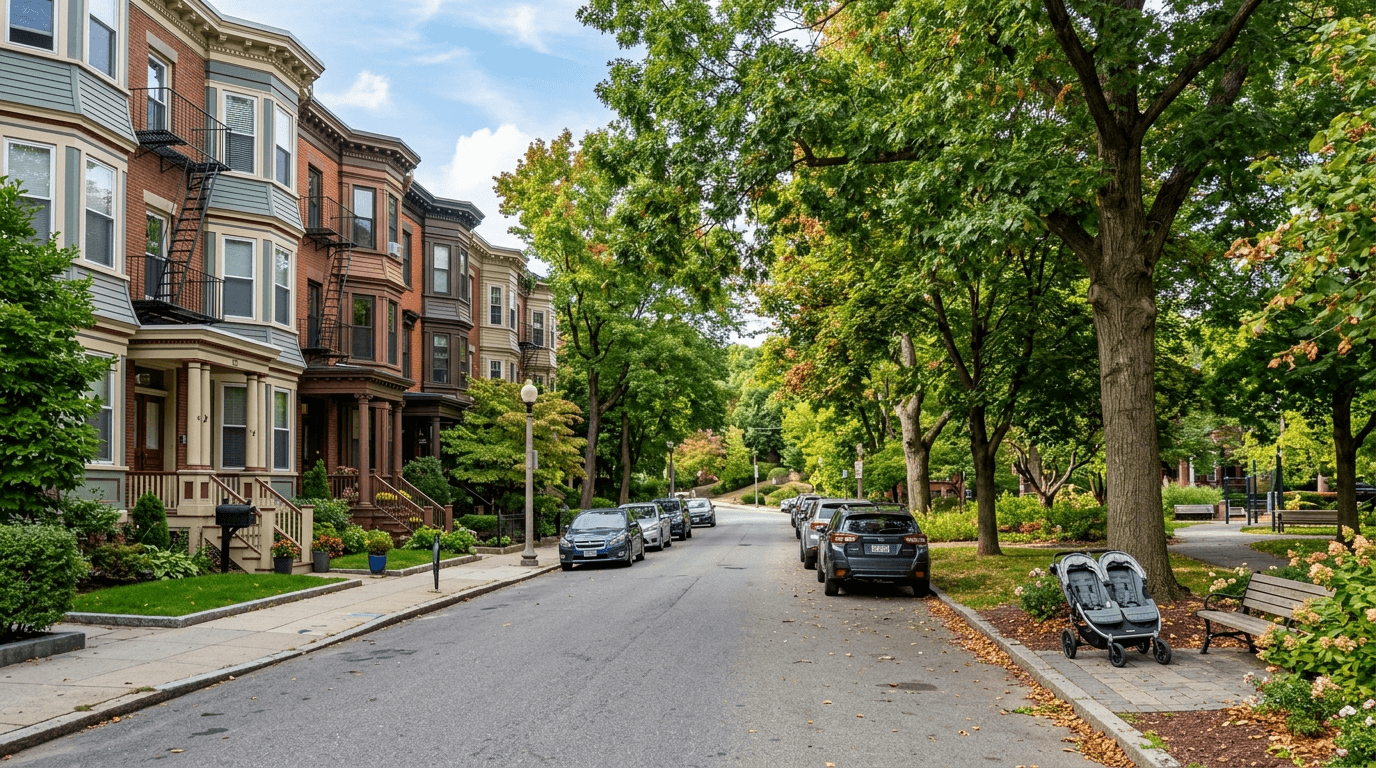
Boston's housing stock for young professionals splits between classic brick townhomes and brownstones in Back Bay and the South End, and sleek modern high-rise condos in the Seaport and Downtown—almost always on compact urban footprints with shared amenities instead of yards.
Here's the mental model I give buyers and renters: in Boston, you're not buying land, you're buying location and lifestyle. Lot sizes are minimal to nonexistent. What you're really paying for is proximity, the building's amenity package—concierge, gym, rooftop deck—and the neighborhood right outside your front door.
The rental market is competitive but not overheated. Citywide asking rents sit just under $3,000 per unit, vacancy is moderate near 6.1%, and absorption is currently outpacing year-to-date deliveries. In plain terms, renters are leasing units faster than developers can hand over the keys.
Boston Multifamily Snapshot: June 2026
A fast headline card for young professionals sizing up Boston’s bustling rental market: rents are near $3,000 per unit, vacancy is moderate, and absorption is outpacing year-to-date deliveries.
For anyone weighing three of the most popular young-professional neighborhoods—North End, Seaport, and Charlestown—the rents tell a clear story:
Typical 1BR and 2BR Rents: North End vs Seaport vs Charlestown
A side-by-side rent comparison for three classic young-professional neighborhoods: Seaport commands the premium, while North End and Charlestown offer more moderate 1–2 bedroom ranges with strong urban access.
North End
Seaport
Charlestown
A side-by-side rent comparison for three classic young-professional neighborhoods: Seaport commands the premium, while North End and Charlestown offer more moderate 1–2 bedroom ranges with strong urban access.
•North End: Historic, Italian, tight-knit, and very walkable. Expect $2,800–$3,600 for a 1BR—strong value for a neighborhood this central.
•Seaport: The premium pick. Modern towers, rooftop nightlife, and the highest rents of the three, with 2BRs running $4,800–$5,800. This is your glass-and-steel, amenity-heavy option.
•Charlestown: More residential and quieter, with better walkability than most people expect and 1BRs around $2,900–$3,300.
If ownership is the goal, price-per-square-foot swings dramatically depending on how central you want to be:
Boston Condo Price per Square Foot by Neighborhood
Condo price-per-square-foot rankings highlight the cost gap between high-energy central neighborhoods and more value-oriented Boston areas—useful for young professionals weighing lifestyle against ownership affordability.
Premium Core
Value Areas
Condo price-per-square-foot rankings highlight the cost gap between high-energy central neighborhoods and more value-oriented Boston areas—useful for young professionals weighing lifestyle against ownership affordability.
The gap is stark. Premium-core neighborhoods like Seaport ($1,699/sq ft) and Back Bay ($1,618/sq ft) command a serious premium for that walk-everywhere lifestyle. Value-oriented areas like Roslindale ($499/sq ft), West Roxbury ($497/sq ft), and Hyde Park ($466/sq ft) offer dramatically more square footage per dollar. The trade-off is a longer commute and a more residential pace. This is the single biggest lever young professionals pull when deciding whether to rent centrally or buy with room to grow.
Where Do Young Professionals Gather in Boston, MA?
Boston's social life clusters around its waterfront, its historic commons, and its shopping-and-dining corridors—giving you distinct options for outdoor recreation, nightlife, and weekend browsing.
The Seaport District has become the default gathering spot for the after-work crowd. It's modern, lively, and built around rooftops, waterfront patios, and events. On the shopping-and-café front, the walkable retail districts do the heavy lifting. If you're near the Financial District, the Rose Fitzgerald Kennedy Greenway is where people actually eat lunch, meet friends, and decompress between meetings.
The recurring hubs I point newcomers toward:
•Boston Common and the Public Garden — the city's green heart for runs, picnics, and people-watching.
•The Seaport waterfront — trendy dining and the most active nightlife scene for the 20s-and-30s crowd.
•Newbury Street and the Prudential Center — the go-to corridor for shopping, cafés, and browsing on a Saturday.
For the fitness-minded, boutique studios are woven right into the daily fabric. The Financial District alone is packed with highly rated options, so squeezing in a class before or after work is realistic. That's the theme across Boston: your social and wellness routines don't require a car or a plan—just a short walk.
How Is the Commute in Boston, MA and Getting Around the City?
Getting around Boston is genuinely easy without a car, thanks to the MBTA "T" subway, two major commuter-rail hubs, and one of the most walkable, bike-friendly street grids in the country.
The mobility numbers make it concrete. A 72.4 Transit Score and a 69.4 Bike Score put Boston among the top-tier cities for car-light living. In practice, this is the number-one reason young professionals choose Boston over the suburbs. While Newton and Belmont offer that quieter village feel our team knows well, Boston lets you skip parking headaches entirely.
Here's how the transit picture breaks down by neighborhood:
•North End: Served by the Green and Orange Lines. No car needed.
•Seaport: Anchored by the Silver Line. No car needed.
•Charlestown: Orange Line plus a ferry option—a car is only sometimes useful here.
•Jamaica Plain: The Orange Line, the popular 39 bus, and commuter rail make it a strong pick for anyone wanting a slightly more residential feel with solid access.
•Somerville (Davis Square): The Red Line plus the Somerville Community Path, a favorite for walkers and cyclists.
The system essentials:
•The MBTA subway runs on four color-coded lines—Red, Green, Orange, and Blue—covering the core and radiating into surrounding neighborhoods.
•South Station and North Station are the major hubs connecting the subway to commuter rail, tying the city to the broader metro area.
•Exceptional walkability and the Bluebikes bike-share network round out an eco-friendly, low-cost daily commute for anyone living centrally.
The honest trade-off: Boston is dense, and driving downtown can be slow and frustrating. But that's precisely why the young-professional playbook here leans hard on the T, walking, and biking. Pick a neighborhood on a line that reaches your office, and your commute becomes one of the easiest parts of your day.
Boston rewards people who want their life close at hand—short commutes, walkable blocks, and a social scene you can reach on foot. Whether you're renting your first place in the North End, weighing a Seaport high-rise, or eyeing a value-priced condo in Roslindale to build equity, the right move comes down to matching your budget to the lifestyle you actually want. When you're ready to map that out block by block, we'd be glad to help you find the corner of the city that fits.
Local Spots & Favorites
Boston Market Statistics
Median sale price, days on market, and closed sales by property type.
Is Boston, MA a good place for families who want walkable city living?
Boston, MA works best for families who want dense, walkable city living rather than large yards and driveways. Housing is typically on compact urban footprints, with green space, dining, transit, and daily errands close by.
Quieter, more residential options include Charlestown, Jamaica Plain, Roslindale, West Roxbury, and Hyde Park, while core areas like Seaport, Back Bay, Downtown, and the North End offer a faster, more urban pace.
What are condos and townhomes like in Boston, MA?
Boston, MA condos and townhomes range from classic brick townhomes and brownstones in Back Bay and the South End to modern high-rise condos in the Seaport and Downtown. Most homes prioritize location, walkability, and building amenities over private outdoor space.
Buyers should expect compact footprints and, in newer buildings, amenities such as concierge service, gyms, and rooftop decks.
How affordable are condos in Boston, MA for first-time buyers?
Boston, MA has a wide cost range depending on neighborhood. Premium-core areas such as Seaport and Back Bay are among the most expensive, with Seaport around $1,699 per square foot and Back Bay around $1,618 per square foot.
More value-oriented neighborhoods include Roslindale at about $499 per square foot, West Roxbury at about $497 per square foot, and Hyde Park at about $466 per square foot, with the trade-off being a longer commute and more residential pace.
How much does it cost to rent in Boston, MA neighborhoods popular with young professionals?
Boston, MA renters should expect citywide asking rents just under $3,000 per unit, with moderate vacancy around 6.1%. North End one-bedrooms typically run about $2,800 to $3,600, while Charlestown one-bedrooms are around $2,900 to $3,300.
Seaport is the premium rental option, with modern towers and higher rents; two-bedrooms there commonly run about $4,800 to $5,800.
Can you live in Boston, MA without a car?
Boston, MA is one of the strongest car-light cities for commuters, with a Walk Score of 82.8, Transit Score of 72.4, and Bike Score of 69.4. The MBTA subway, known as the T, runs on the Red, Green, Orange, and Blue Lines, with South Station and North Station serving as major commuter-rail hubs.
Many central neighborhoods do not require a car. North End is served by Green and Orange Line access, Seaport by the Silver Line, and Charlestown by the Orange Line plus a ferry option.
Which Boston, MA neighborhoods are best for commuting?
The best Boston, MA neighborhoods for an easier commute are those directly connected to the MBTA line serving your workplace. North End, Seaport, Charlestown, Jamaica Plain, and Davis Square in Somerville all offer strong transit access, with walking and biking options built into daily routines.
Driving downtown can be slow and frustrating, so the most practical commute strategy is choosing a neighborhood with direct T, bus, ferry, commuter rail, or bike access to work.
What should families consider about schools and neighborhoods in Boston, MA?
Families evaluating schools in Boston, MA should compare neighborhoods at the address level while also considering commute, housing type, and daily walkability. The city’s neighborhoods vary significantly in pace, density, housing cost, and transit access.
For families prioritizing a more residential feel, areas such as Charlestown, Jamaica Plain, Roslindale, West Roxbury, and Hyde Park offer alternatives to the denser downtown and waterfront neighborhoods.